Double crochet is one of the most useful basic crochet stitches because it creates height
quickly without making the fabric as dense as single crochet. Once the movement becomes comfortable,
you will see it everywhere: blankets, granny squares, garments, shells, stripes, textured stitches and
many beginner patterns.
If you are still getting comfortable with chains, yarn tension and where to insert the hook, start with our
Crochet for Beginners guide. This article focuses specifically on how double crochet
is formed, how to recognize the stitch, count rows, handle turning chains and correct the mistakes beginners
make most often.
In U.S. crochet terminology, double crochet is abbreviated dc.
The basic motion is: yarn over, insert the hook, pull up a loop, then work the loops off in two stages.
What Makes Double Crochet Different?
The basic crochet stitches are mainly distinguished by height and by how the loops are worked from the hook.
Double crochet is taller than single crochet and half double crochet, but shorter than treble crochet.
That extra height means each row grows faster and usually produces a more open fabric.
| U.S. stitch | Abbreviation | Relative height | Fabric character | U.K. equivalent name |
|---|---|---|---|---|
| Single crochet | sc | Short | Dense and firm | Double crochet |
| Half double crochet | hdc | Medium | Solid with moderate height | Half treble |
| Double crochet | dc | Tall | Flexible, faster-growing, slightly open | Treble |
| Treble crochet | tr | Very tall | Open and elongated | Double treble |
This terminology difference matters. A U.S. double crochet is called a
treble in U.K. terminology, so always check which system the pattern uses before starting.
How to Make a Double Crochet Stitch
The source lesson teaches double crochet after the chain and single crochet, which makes sense:
the stitch adds one yarn-over before the hook enters the work and then removes the loops in two stages.
Here is the same technique summarized in original wording.
-
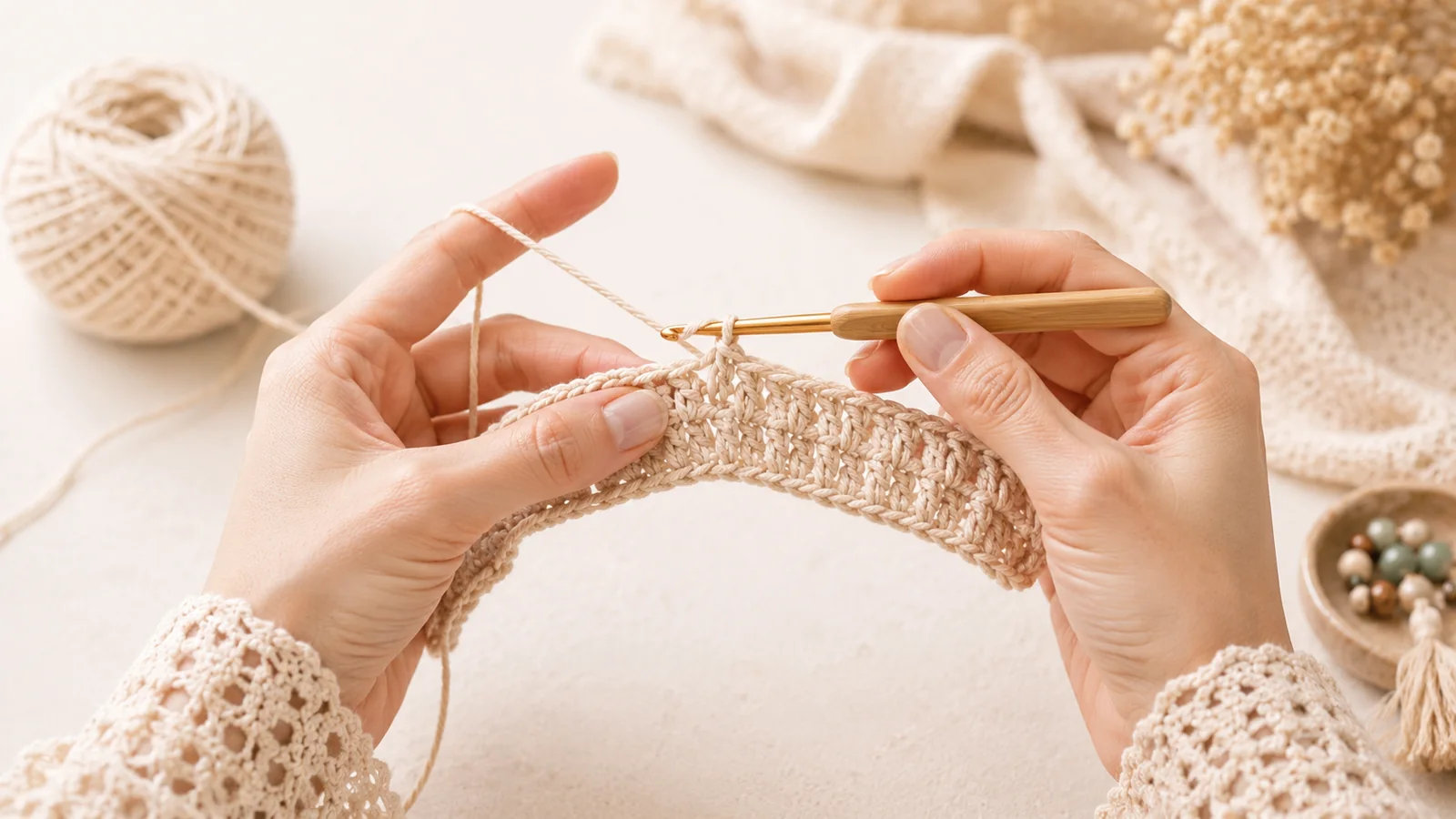
Yarn over once.
Bring the working yarn over the hook before inserting it into the stitch. -
Insert the hook.
Put the hook into the next stitch or foundation chain position specified by the pattern. -
Pull up a loop.
Yarn over again and draw the yarn through the stitch. You should now have three loops on the hook. -
Work through two loops.
Yarn over and draw through the first two loops. Two loops remain. -
Finish the stitch.
Yarn over once more and draw through the final two loops. One loop remains on the hook.
The hook should move smoothly through the loops. If you have to force it, loosen your yarn tension slightly.
If the loops become very large and uneven, slow down and shorten the working loop on the hook.
Practice Double Crochet in Real Projects
Use the stitch in blankets, granny squares, bags, baby projects and more across the full crochet collection.
Turning Chains: Why They Confuse Beginners
When rows are worked back and forth, the working yarn must be brought up to the height of the next row.
Traditional double-crochet instructions often use a chain-three turning chain and may count it as the first
stitch of the row. However, modern patterns do not all handle turning chains the same way.
When the turning chain counts as a stitch
The next double crochet is usually worked into the following stitch so you do not accidentally increase.
At the opposite edge, you may need to work into the top of the turning chain to keep the stitch count correct.
When it does not count
Some designers use a shorter or alternative turning method and tell you to work into the first stitch.
In that case, follow the pattern instructions rather than applying a universal rule.
The safest habit is simple: read the pattern note about the turning chain before starting the first row.
It prevents both widening edges and missing stitches.
How to Count Double Crochet Stitches and Rows
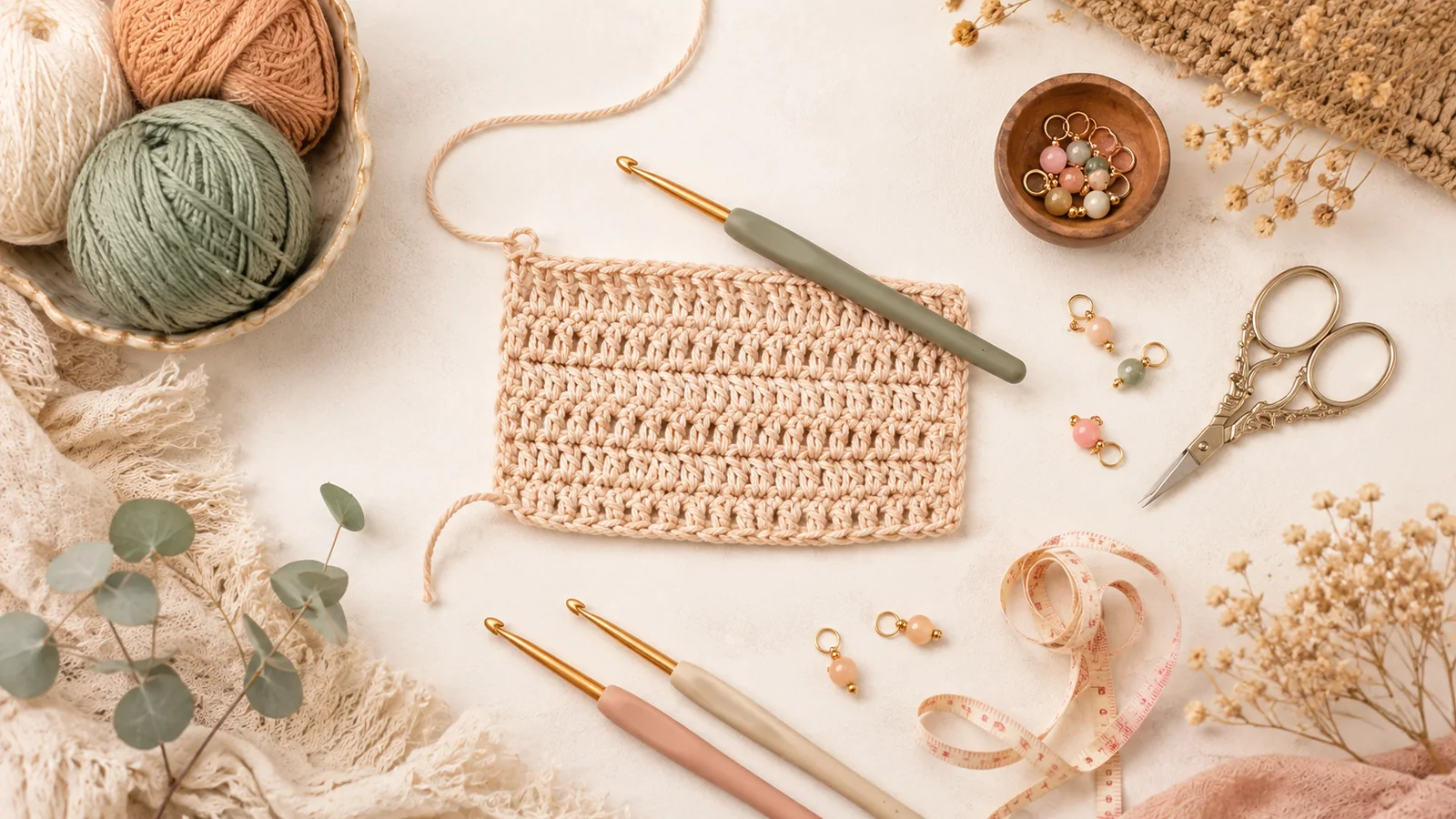
A completed double crochet has a clear top “V” and a tall vertical post below it. For stitch counting,
look across the top edge. For row counting, look at the horizontal bands of posts stacked above one another.
| What you are counting | Where to look | Common mistake |
|---|---|---|
| Stitches in a row | The top V of each completed stitch | Forgetting whether the turning chain counts |
| First stitch | The first usable V after the turning edge | Working into the same place twice |
| Last stitch | The final V or the top of the turning chain, depending on the pattern | Missing the edge stitch and making the work narrower |
| Rows | The horizontal layers of tall stitch posts | Counting the foundation chain as a full row |
Mark the first and last stitch while learning. It makes straight edges much easier to maintain.
Why Double Crochet Works So Well for Blankets
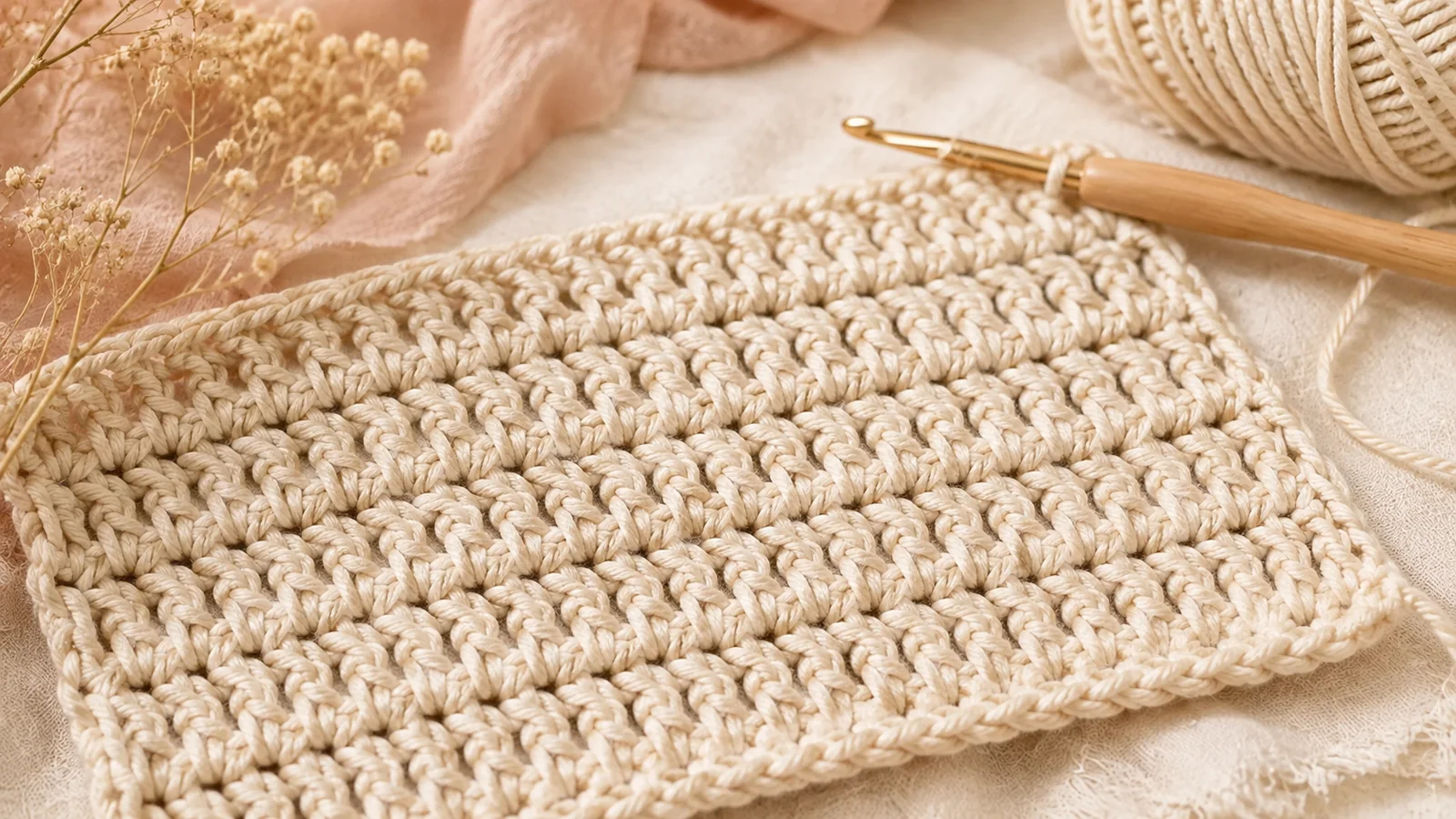
Double crochet grows faster than shorter stitches, so it is a practical choice for larger projects.
It can be worked alone, alternated with other stitches, grouped into shells, combined with chains for openwork,
or used in post-stitch textures.
In your blanket collection, double crochet appears in everything from simple rows to shell patterns,
basket-weave textures and ripple-style designs. If blankets are what you want to make next, our
Crochet Blanket Guide explains yarn weight, sizing, gauge, construction and borders
in more detail.
- Simple rows: good for practicing consistent tension.
- Shells: several tall stitches grouped into one space create decorative fans.
- Post stitches: working around the stitch post creates raised texture.
- Ripples: increases and decreases can shape double-crochet rows into waves.
- Granny-style clusters: grouped tall stitches create the classic open motif look.
Ready to Turn the Stitch Into a Project?
Browse 800+ crochet patterns and choose a project where you can practice stitches, texture and shaping.
Double Crochet Troubleshooting
| Problem | Most likely reason | What to check |
|---|---|---|
| Rows keep getting narrower | The last stitch is being missed | Count the top V stitches and check the turning-chain rule. |
| Rows keep getting wider | An extra stitch is being added at the turning edge | Check whether the turning chain already counts as a stitch. |
| Stitches look short and stiff | Tension may be too tight | Relax the yarn hand and make sure the working loop is not pulled tightly around the hook. |
| Large gaps appear at row edges | The turning chain may be taller than the surrounding stitches | Follow the pattern’s turning method; do not automatically substitute your own. |
| Stitch count is correct but the piece is too wide | Your gauge is looser than the pattern gauge | Make a swatch and compare stitches per measured width. |
A Simple Double Crochet Practice Plan
Instead of starting with a large project immediately, spend a short session learning what the stitch should
look and feel like. The goal is not perfection; it is consistent movement and reliable counting.
- Make a relaxed foundation chain. Avoid pulling each chain tight.
- Work one row slowly. Pay attention to the three loops that appear after pulling up yarn.
- Count before turning. Confirm the row has the number of stitches you expected.
- Work several more rows. Watch whether the side edges remain straight.
- Measure and compare. If you are following a pattern, compare the swatch with its gauge information.
Once this feels comfortable, try the stitch in a real project. A blanket is forgiving because double crochet
can repeat over long rows, while a lined bag can show you how a taller stitch behaves when structure matters.
For that second case, see the Crochet Bag Guide.
Double Crochet Variations You Will See in Patterns
Learning the basic stitch also makes several common variations easier to understand. They all start from
the same double-crochet movement but change where or how the stitch is completed.
- dc2tog
- Two double crochets are partially worked and then finished together to create a decrease.
- Front post double crochet (FPdc)
- The hook works around the post of the stitch from the front, creating raised texture.
- Back post double crochet (BPdc)
- The hook works around the post from the back, pushing the stitch texture in the opposite direction.
- Double crochet shell
- Several double crochets are worked into the same stitch or space to create a fan-like group.
Standard U.S. pattern abbreviations use dc for double crochet, dc2tog for
a double-crochet decrease, and forms such as FPdc and BPdc for post stitches.
Always check the pattern key when a designer introduces a special abbreviation.
When Double Crochet Is — and Is Not — the Best Choice
| Good fit | Why | When another stitch may work better |
|---|---|---|
| Blankets and throws | Rows gain height quickly and can be made solid or decorative. | Use shorter stitches if you want a denser, heavier fabric. |
| Garments and wraps | The taller stitch can create more drape and flexibility. | Very open dc fabric may need layering depending on the design. |
| Granny-style motifs | Double-crochet groups create classic clusters efficiently. | A denser motif may use single or half double crochet. |
| Bags | Useful for decorative or lined designs. | For an unlined bag that must hold small items, a denser stitch may be more practical. |
Double Crochet FAQ
Is double crochet easy for beginners?
Yes. It adds one yarn-over and one extra loop-working stage compared with single crochet, but the movement
becomes repetitive quickly. It is one of the core stitches worth learning early.
How many loops should be on the hook during double crochet?
After you yarn over, insert the hook and pull up a loop, there are three loops on the hook. They are then
worked off two loops at a time until one loop remains.
Does a chain three always count as a double crochet?
No. Traditional instructions often count it, but modern patterns vary. Follow the turning-chain instructions
written in the pattern you are using.
Why are my double-crochet edges uneven?
The usual cause is inconsistent treatment of the first or last stitch. Mark the edges and confirm whether
the turning chain counts as a stitch.
Is U.K. double crochet the same stitch?
No. U.K. double crochet corresponds to U.S. single crochet. The U.S. double crochet covered in this guide
is called treble crochet in U.K. terminology.
Keep Building Your Crochet Skills
Explore blankets, bags, granny squares, tops, baby crochet, jewelry, kitchen projects and more.