Crochet for Beginners: Hooks, Yarn, Basic Stitches & First Projects
Learning crochet for beginners does not require dozens of stitches or a huge collection
of tools. A crochet hook, suitable yarn and a few basic movements are enough to begin making useful
projects and understanding simple crochet patterns.
This beginner guide walks through the supplies you actually need, how yarn and hook size work together,
the first stitches worth learning, tension, pattern abbreviations, gauge and a few good first-project ideas.
The goal is to give you a clear foundation without making crochet feel more complicated than it is.
- Choose a smooth, medium-weight yarn that makes each stitch easy to see.
- Use the hook size suggested for the yarn or pattern instead of guessing.
- Learn the chain, slip stitch, single crochet, half double crochet and double crochet first.
- Practice even tension before worrying about speed.
- Begin with a small project or practice swatch so mistakes are easy to fix.
What You Need to Start Crochet for Beginners
Crochet can be started with very little equipment. The beginner lessons in the crochet books in this
collection repeatedly come back to the same essentials: yarn, a crochet hook and a tapestry or yarn needle.
Crochet Hook
Hooks come in different diameters. A pattern normally tells you which size to start with, and you may
adjust slightly when gauge requires it.
Yarn
Yarn varies in thickness, fibre and texture. For practice, a smooth medium or worsted-weight yarn is
easier to see and handle than very fine, fuzzy or novelty yarn.
Tapestry Needle
A blunt yarn needle is useful for weaving in loose ends and finishing projects neatly.
Helpful Extras
Scissors, stitch markers and a tape measure are inexpensive extras that become useful as soon as you
move from practice swatches to full projects.
loops of each stitch than black, fuzzy or highly textured yarn.
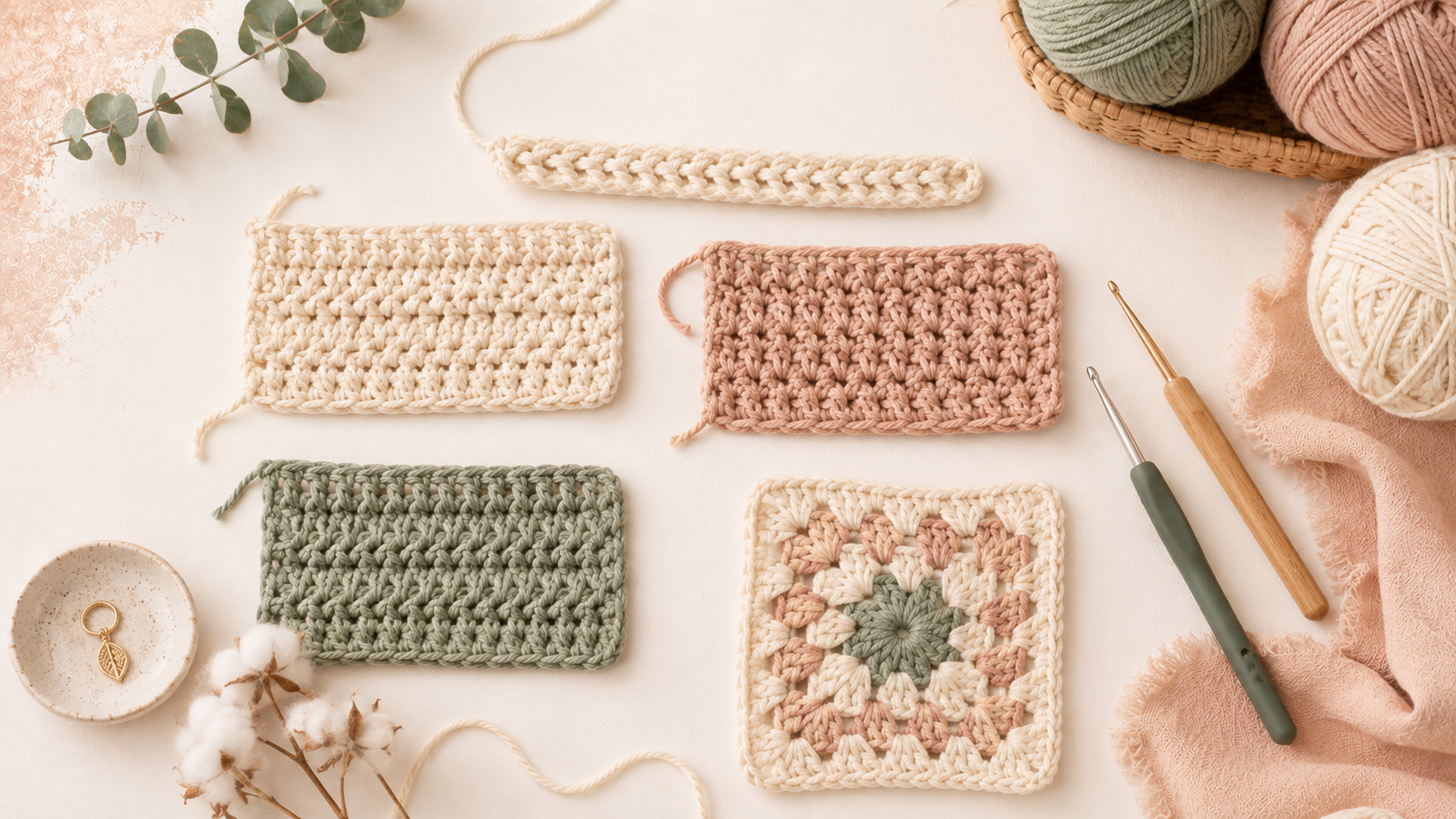
You only need a few basic tools to begin learning crochet.
How to Choose Crochet Yarn and Hook Size
Yarn and hook size work together. The combination affects stitch size, fabric density, drape and the
final measurements of a project.
Read the yarn label
Yarn labels commonly tell you the yarn weight, fibre content, amount in the ball or skein and care
instructions. Many also provide a suggested crochet hook range.
Follow the pattern first
When you are using a pattern, begin with its recommended yarn category and hook size. If your stitches
do not match the required gauge, the hook size can be adjusted.
The Craft Yarn Council maintains a standardized yarn-weight system that groups yarn from very fine to jumbo
and gives common hook-size ranges. These ranges are useful as guidance, but the gauge written in the pattern
remains more important for a specific project.
Holding the Hook, Yarn and Finding Comfortable Tension
There is no single perfect hand position. What matters is that the hook moves comfortably and the yarn
feeds at a steady tension.
Beginners often crochet too tightly because they are concentrating on controlling every loop. Very tight
stitches make it difficult to insert the hook and can make the hands tire quickly. If the work feels stiff
and the hook is difficult to move, deliberately relax your yarn hand and make a short practice chain again.
If your stitches are too tight
Relax your grip, avoid pulling each loop firmly against the hook and practice making several chains
with the loops resting naturally on the hook shaft.
If your stitches are too loose
Add a little more control with the yarn hand and make sure the working yarn is not feeding freely
without resistance.
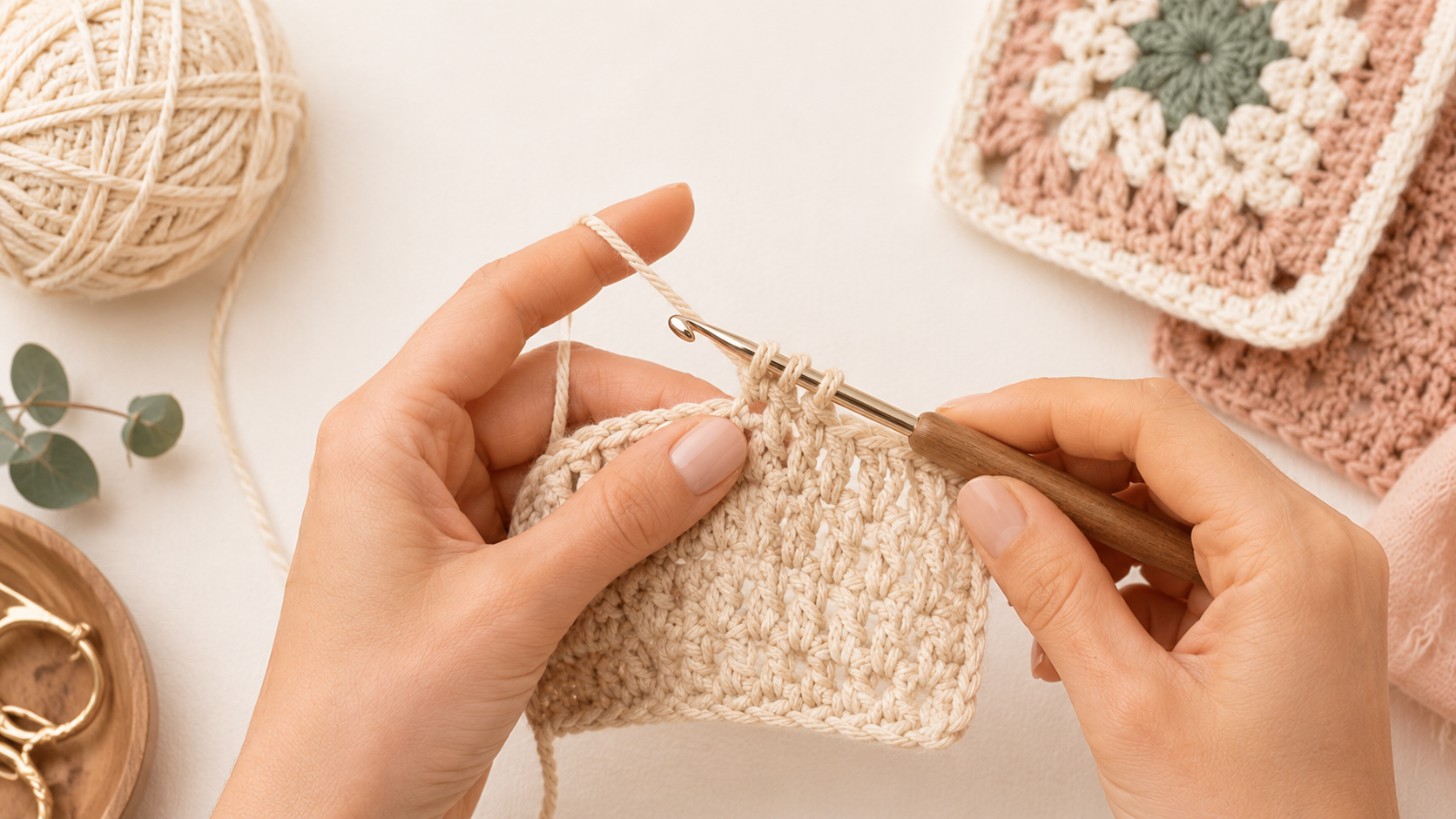
Aim for comfortable, repeatable tension rather than pulling every stitch tight.
Start with a Slip Knot and Foundation Chain
The chain is one of the first crochet skills most beginners learn and it forms the starting foundation
for many projects worked in rows.
Slip knot
Make an adjustable loop in the yarn and place it on the hook. Tighten it enough to sit securely while
still allowing the loop to slide along the hook.
Foundation chain
Yarn over the hook and draw the yarn through the loop already on the hook. Repeat to build a chain.
Try to keep each chain close to the same size.
A very tight foundation chain can make the first row difficult and may pull the lower edge of the project
inward. Smooth, relaxed chain stitches are easier to work into.
5 Crochet Stitches Beginners Should Learn First
These stitches and movements appear constantly in beginner crochet projects. Learning them gives you
enough vocabulary to start reading many simple patterns.
1. Chain — ch
Creates a foundation, spacing between stitches and turning chains.
2. Slip Stitch — sl st
Used for joining, moving across stitches and creating very low-profile crochet.
3. Single Crochet — sc
A short, dense stitch that is excellent for practicing consistent stitch placement.
4. Half Double Crochet — hdc
Taller than single crochet and useful when you want a little more height without a very open fabric.
5. Double Crochet — dc
A taller stitch used throughout blankets, garments, granny squares and many other crochet projects.
names for several of the same stitch structures.
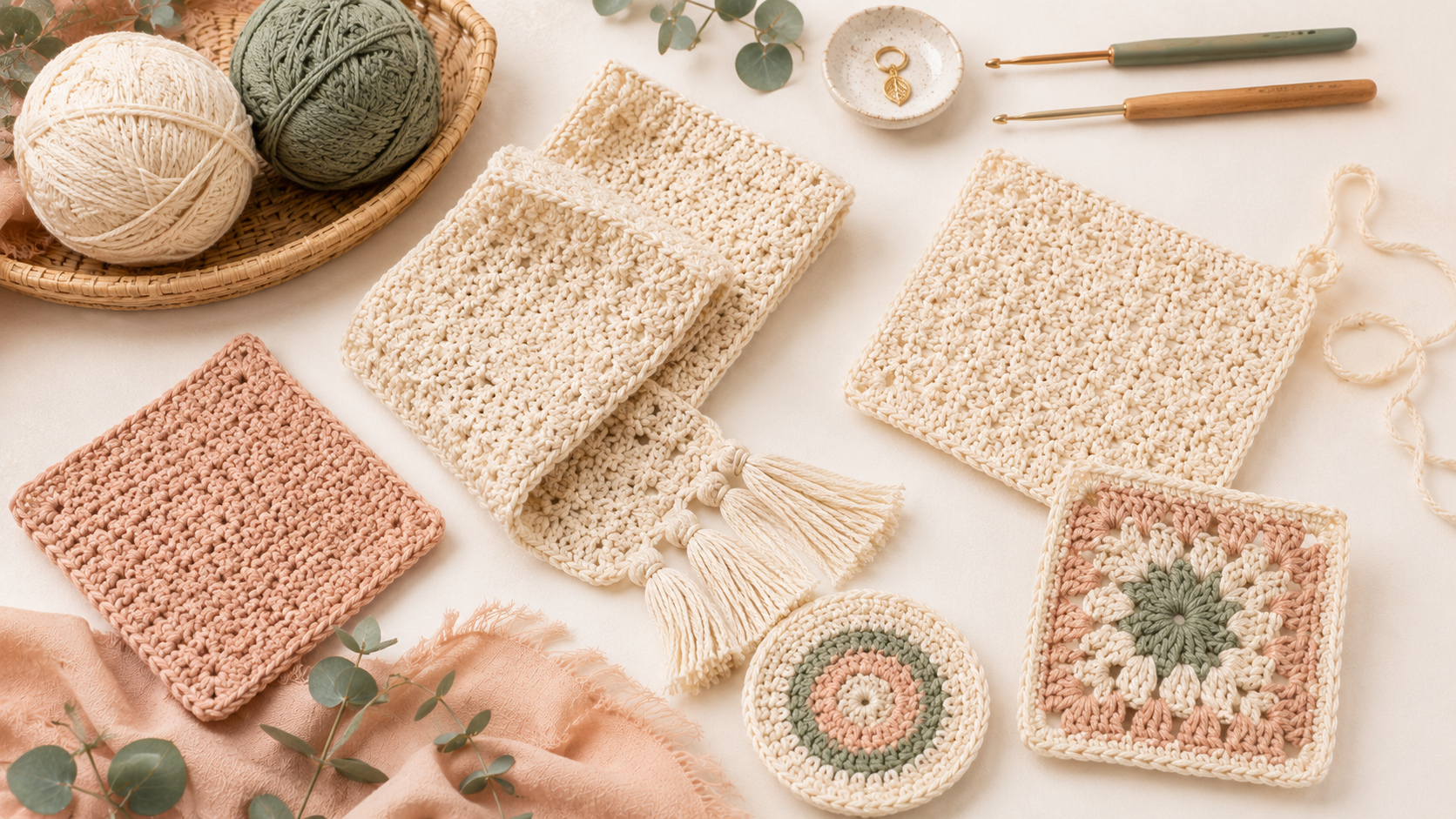
Practice basic stitches in small samples before using them in a larger project.
U.S. vs U.K. Crochet Terms: Check Before You Start
A pattern written in U.S. terminology can use the same stitch name differently from a U.K. pattern.
Checking the terminology before crocheting prevents major mistakes.
U.S. single crochet
Called double crochet in U.K. terminology.
U.S. half double crochet
Called half treble in U.K. terminology.
U.S. double crochet
Called treble in U.K. terminology.
Slip stitch
The stitch itself is the same, although the abbreviation may appear as sl st or ss.
The Craft Yarn Council publishes a crochet abbreviation reference that also shows common U.S. and U.K.
terminology differences.
Counting Crochet Stitches and Turning Rows
Accidentally adding or losing stitches is one of the most common reasons a beginner rectangle starts
getting wider or narrower.
Count the stitches
Count the top loops across the row occasionally instead of waiting until the piece has changed shape.
Stitch markers can help identify the first and last stitch.
Know whether the turning chain counts
Patterns do not all treat turning chains the same way. Read the pattern notes instead of assuming the
turning chain is automatically a stitch.
Stop every few rows, spread the work flat and look at the overall shape. Catching an accidental increase
or decrease early is much easier than undoing a large section later.
What Crochet Gauge Means and When It Matters
Gauge describes how many stitches and rows fit into a measured area. It is especially important for
garments, fitted accessories and projects where the final dimensions matter.
Two people can use the same yarn and hook but produce different-sized stitches because their tension is
different. That is why a pattern may tell you to change hook size until your swatch matches its stated gauge.
Make a gauge swatch
Crochet a sample larger than the measurement area, let the stitches relax, then measure the center of the
swatch. If the stitch count is not close to the pattern gauge, adjust the hook size and test again.
washing or blocking. Testing the swatch can show you what the finished fabric is likely to do.
Easy Things to Crochet for Beginners
A good first project repeats a small number of stitches and lets you practice without complicated shaping.
Practice Swatches
Small squares let you learn a stitch, count rows and experiment with tension without pressure.
Simple Scarf
A rectangle worked back and forth is useful for practicing row edges and consistent stitch counts.
Dishcloth or Washcloth
A small square project gives useful practice while producing something practical.
Basic Granny Square
A classic next step when you are ready to learn working in rounds, corners and repeated stitch groups.
Ready for a useful project with more structure? Our
Crochet Bag Guide explains yarn, stitch density, handles, lining and construction for totes, purses and market bags.
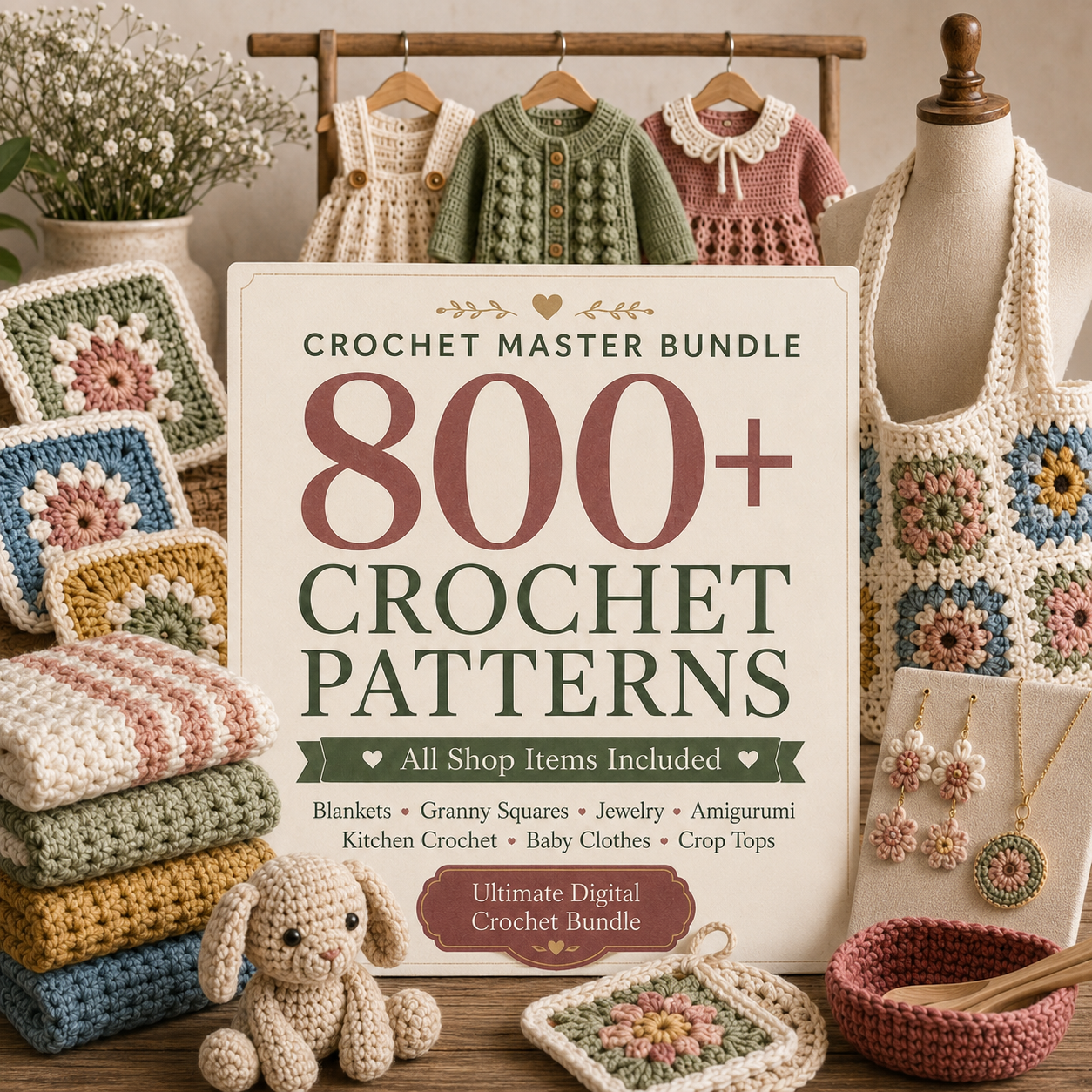
Explore the Full 800+ Crochet Patterns Master Bundle
When you are ready to move from practice stitches into real projects, the complete crochet collection
brings together blankets, granny squares, crochet jewelry, bags, baby projects, tops, kitchen crochet
and more in one large digital library.
Multiple Crochet Categories
Digital PDF Collection
Common Beginner Crochet Problems
My hook will not fit into the stitches
Your tension may be too tight. Relax the working yarn and avoid pulling loops hard against the hook.
My rows keep getting narrower
You may be missing the first or last stitch. Count the row and mark the edge stitches if needed.
My rows keep getting wider
You may be working twice into an edge stitch or treating a turning chain as an extra stitch.
My project is the wrong size
Check your yarn, hook and gauge. Small differences repeated across many stitches can change the final size.
Beginner Crochet Questions
What is the easiest crochet stitch for a beginner?
Start with the chain, then practice single crochet. Once those movements feel comfortable, move to
half double crochet and double crochet.
What yarn is easiest for learning crochet?
A smooth, light-colored medium-weight yarn is usually easier to see and control than very dark, fuzzy,
slippery or extremely fine yarn.
How long does it take to learn crochet?
The basic movements can be learned quickly, but consistent tension and comfortable stitch placement
improve through repetition. Short, regular practice sessions are more useful than trying to master
everything at once.
Do I need to learn every crochet stitch before using patterns?
No. Learn the common basics first and add new stitches as individual projects require them. Most
patterns define unusual stitches or include a special-stitch section.
Should beginners use U.S. or U.K. crochet terminology?
Either is fine. The important thing is to identify which terminology a pattern uses before you begin,
because several stitch names are different.
Build Your Crochet Project Library
Use the basic stitches from this guide as your foundation, then explore a large variety of crochet
projects across blankets, granny squares, accessories, bags, clothing and home projects.