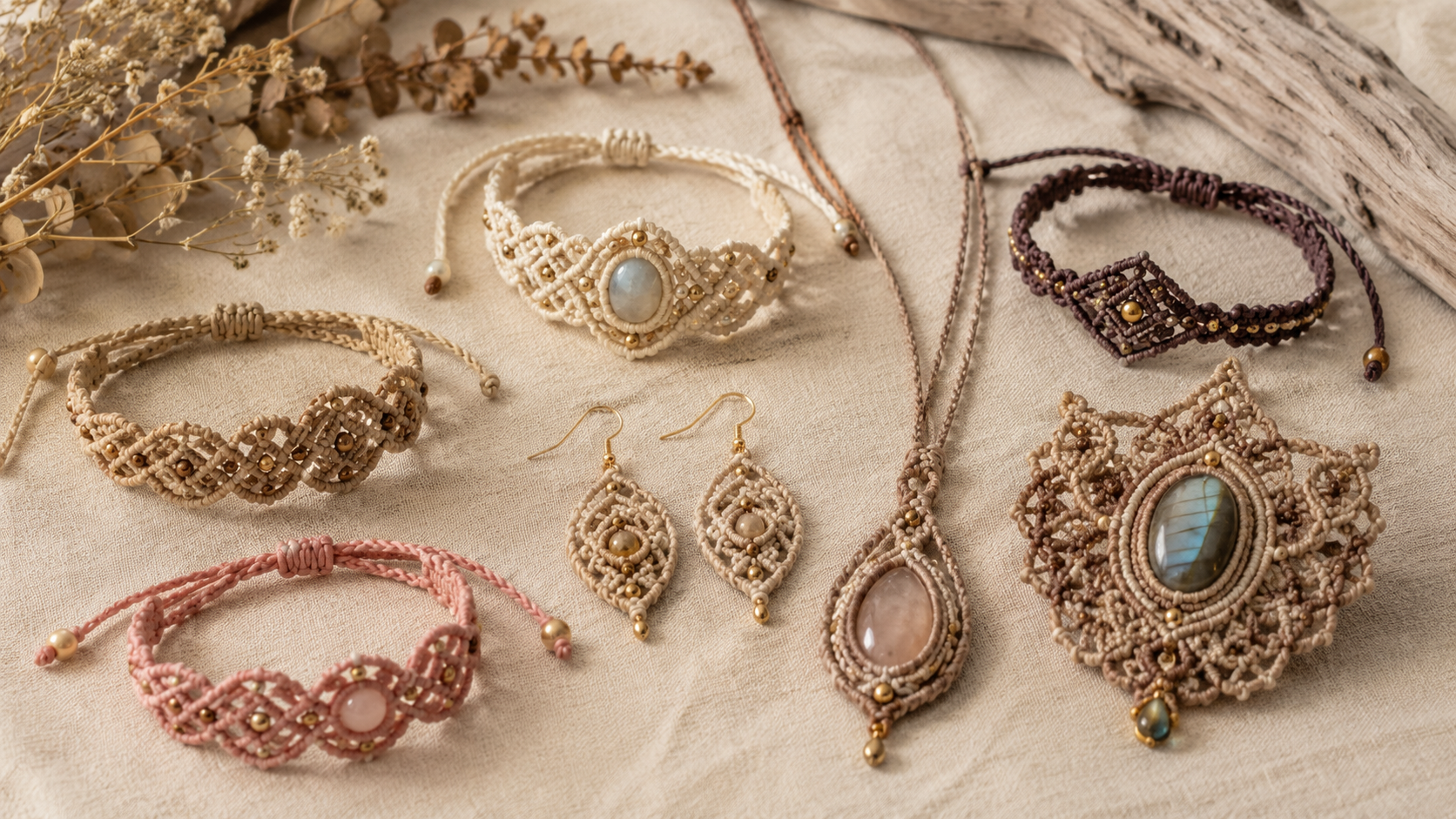
Macrame jewelry is made by knotting fine cord into bracelets, necklaces, earrings,
pendants and other wearable pieces. For beginners, the most important things to learn
are not dozens of knots at once, but how to choose the right cord, keep tension even,
measure accurately, add beads or stones securely and finish the piece cleanly.
This guide walks through those practical details step by step, so you can understand
why a piece works — not just copy a finished design.
How Macramé Jewelry Is Built
Macramé does not use stitches like knitting or crochet. The cords themselves become
the structure. Different knot directions, cord thicknesses and spacing create flat bands,
spirals, curves, openwork, gemstone frames and decorative edges.
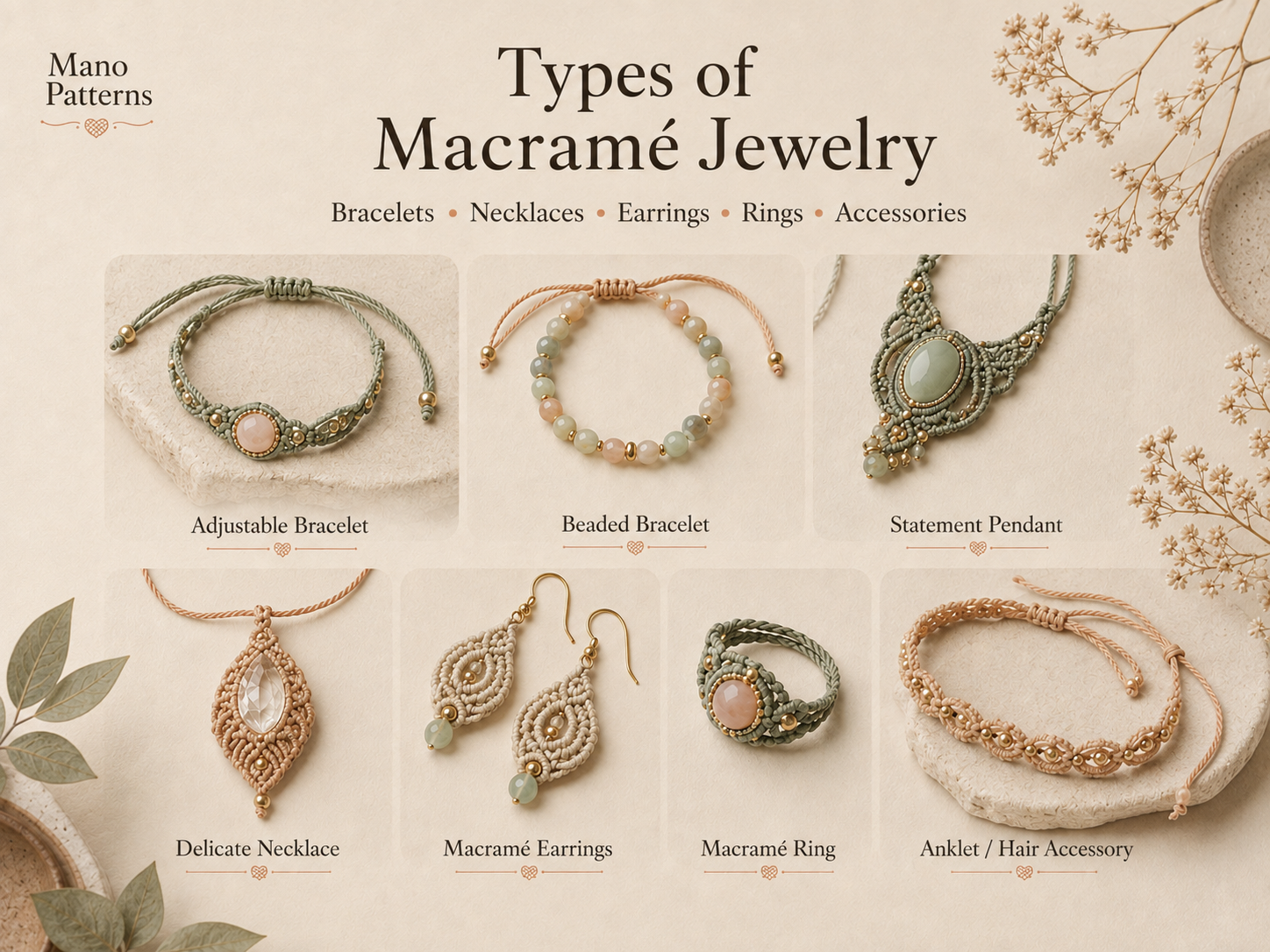
The same basic knotting principles can be adapted to bracelets, necklaces, earrings,
rings and other small accessories.
Flat knotted bands
Square knots are often worked around one or more filler cords. This creates a flexible,
flat strip that works well for bracelets, anklets and narrow necklace sections.
Spirals
Repeating the same half of a square knot makes the work twist naturally.
This is useful when you want a decorative rope-like effect instead of a flat band.
Curves & shapes
Double half hitches can follow an angled guide cord, allowing you to create chevrons,
leaves, arcs and frames around beads or stones.
Stone-centered jewelry
Gemstones are held by a knotted frame or net. The frame must support the stone from
several directions so it cannot slide out when the jewelry moves.
Macrame Jewelry Tools & Materials
Jewelry-scale macramé uses fewer tools than many crafts, but small details matter more.
A stable work surface and compatible cord, beads and findings will save a lot of frustration.
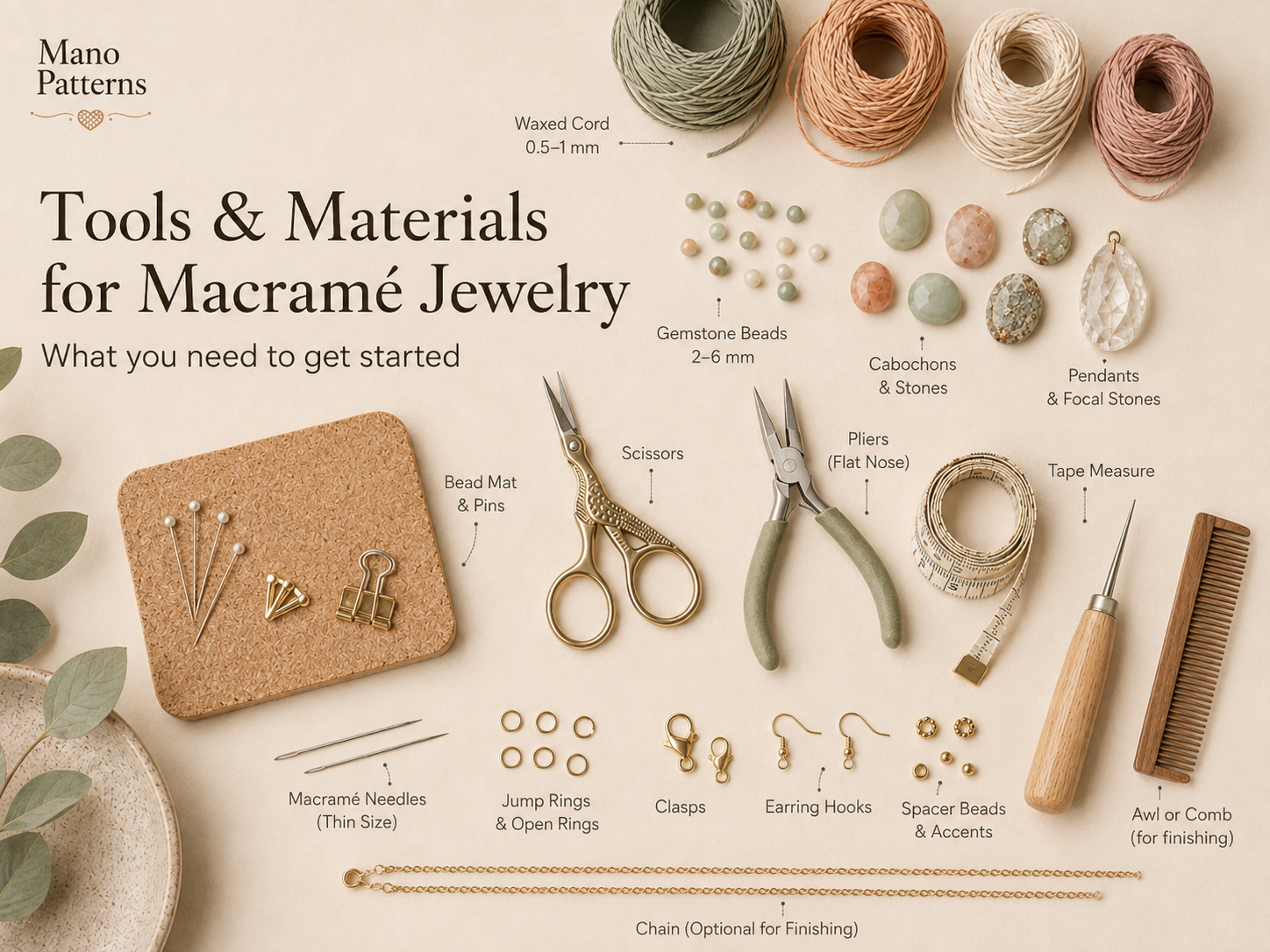
A useful beginner setup includes fine cord, scissors, measuring tools, pins,
jewelry findings, beads and a firm knotting surface.
| Item | Why you need it | What to check |
|---|---|---|
| Macramé cord | Creates the entire structure. | Diameter, flexibility, surface texture and finishing method. |
| Knotting board | Keeps the project from moving. | It should hold pins or clips securely. |
| T-pins / clips | Anchor loops, clasps and guide cords. | Smooth edges prevent snagging fine cord. |
| Sharp scissors | Create neat cord ends. | Small pointed blades are easier around close knots. |
| Pliers | Attach clasps and open jump rings. | Two small jewelry pliers give better control. |
| Beads & stones | Add decoration and focal points. | The hole or setting must fit your actual cord. |
| Findings | Clasps, rings, ear wires and connectors. | Match their size and weight to the jewelry. |
thread one test piece through the smallest bead or finding. If it frays, jams or needs force,
change the cord or bead before you start the project.
Choosing the Right Cord
For macrame jewelry, cord diameter controls knot size, drape and detail. Cord material controls softness,
fraying, grip and how the ends can be finished.
0.4–0.6 mm
Best for very fine micro-macramé, seed beads, detailed earrings and intricate gemstone work.
It gives excellent detail but exposes uneven tension quickly.
0.7–0.8 mm
A versatile jewelry range for bracelets, pendants and beaded pieces.
The knots stay defined without becoming bulky.
0.9–1.2 mm
Easier for beginners to see and handle. Useful for simple bracelets,
chunkier pendants and casual necklaces.
Above 1.2 mm
Better for intentionally bold jewelry. Fine details become larger very quickly,
so this size is usually less suitable for delicate micro-macramé.
Cord material matters too
- Waxed polyester: crisp, durable and popular for micro-macramé and gemstone jewelry.
- Nylon: smooth, strong and useful for fine knotting and beadwork.
- Cotton: soft and natural-looking but can fuzz or fray more at very small sizes.
- Hemp / linen-style cord: firmer and more organic-looking, ideal for rustic designs.
If a pattern recommends 0.8 mm cord, do not automatically replace it with 1.5 mm.
Larger cord changes the knot size, bead compatibility and finished dimensions.
Essential Macrame Jewelry Knots
These four techniques cover much of what a beginner needs for bracelets,
pendants and simple jewelry structures.
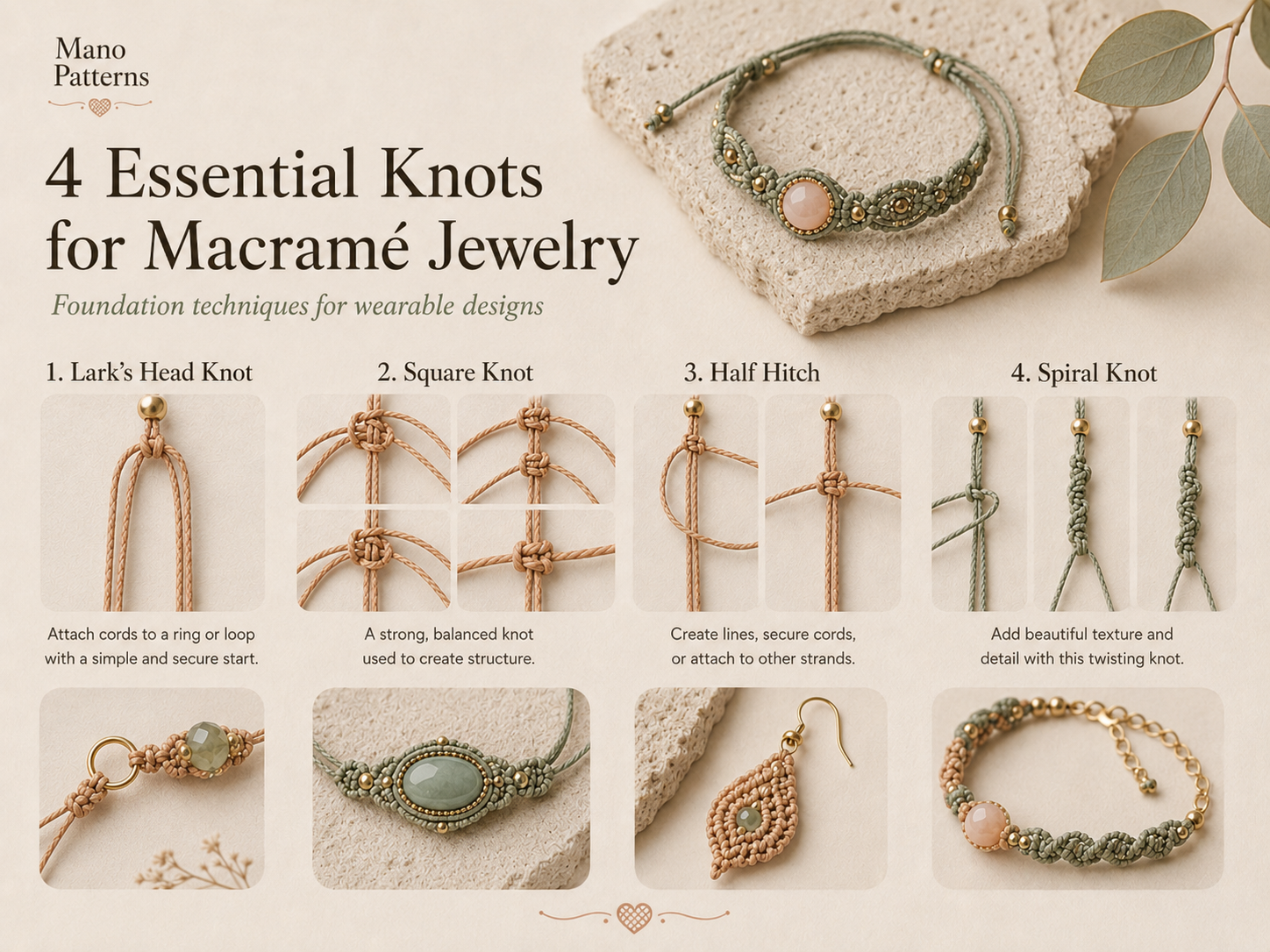
Lark’s head knot
Used mainly to attach folded cords to a ring, bar, clasp or anchor cord.
It is often the starting point of a design.
Square knot
Made from two alternating half knots. It produces a stable, flat band and
is one of the easiest knots for bracelets.
Half-square / spiral knot
Repeating only one half of the square knot makes the cord twist into a spiral.
If your bracelet twists when it should be flat, this is often the reason.
Double half hitch
A working cord knots around a guide cord. Changing the guide cord’s direction
creates diagonals, curves, chevrons and gemstone frames.
Follow Clear Patterns From Start to Finish
Choose a project with easy-to-follow instructions and work through each step
from the first knot to the finished piece.
Easy Instructions
Practical Projects
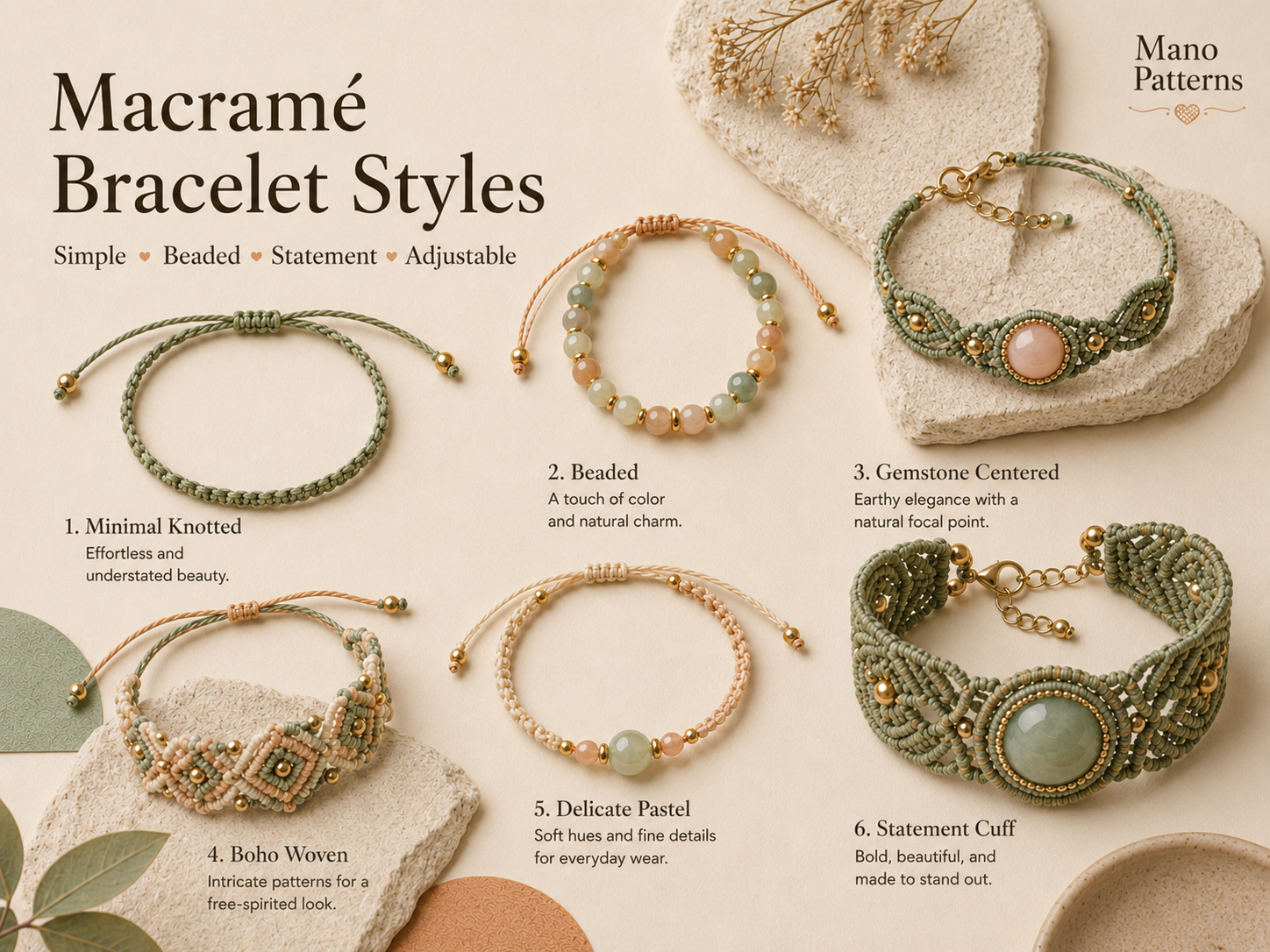
Macrame Jewelry Bracelets
Bracelets are excellent first projects because they teach sizing, repeated tension,
straight edges and closures without requiring a large amount of cord.
Measure correctly
Measure where the bracelet will sit, then include the length added by the clasp,
button loop or sliding closure. Measuring only the knotted center often makes the finished piece too long.
Keep the band straight
Uneven pulling causes one edge to shrink and the bracelet to curve.
Flatten the work every few rows and compare both sides.
Choose the closure early
Sliding knots are adjustable, button loops are simple and decorative,
and lobster clasps give a more traditional jewelry finish.
Add beads carefully
Thread beads onto the correct filler or working cord, center them before tightening,
and check that the surrounding knots do not pull the bead sideways.
Macramé Necklaces & Pendants
In macrame jewelry, necklace construction depends on the focal point, finished length and weight of the design.
A small pendant behaves very differently from a wide gemstone statement necklace.
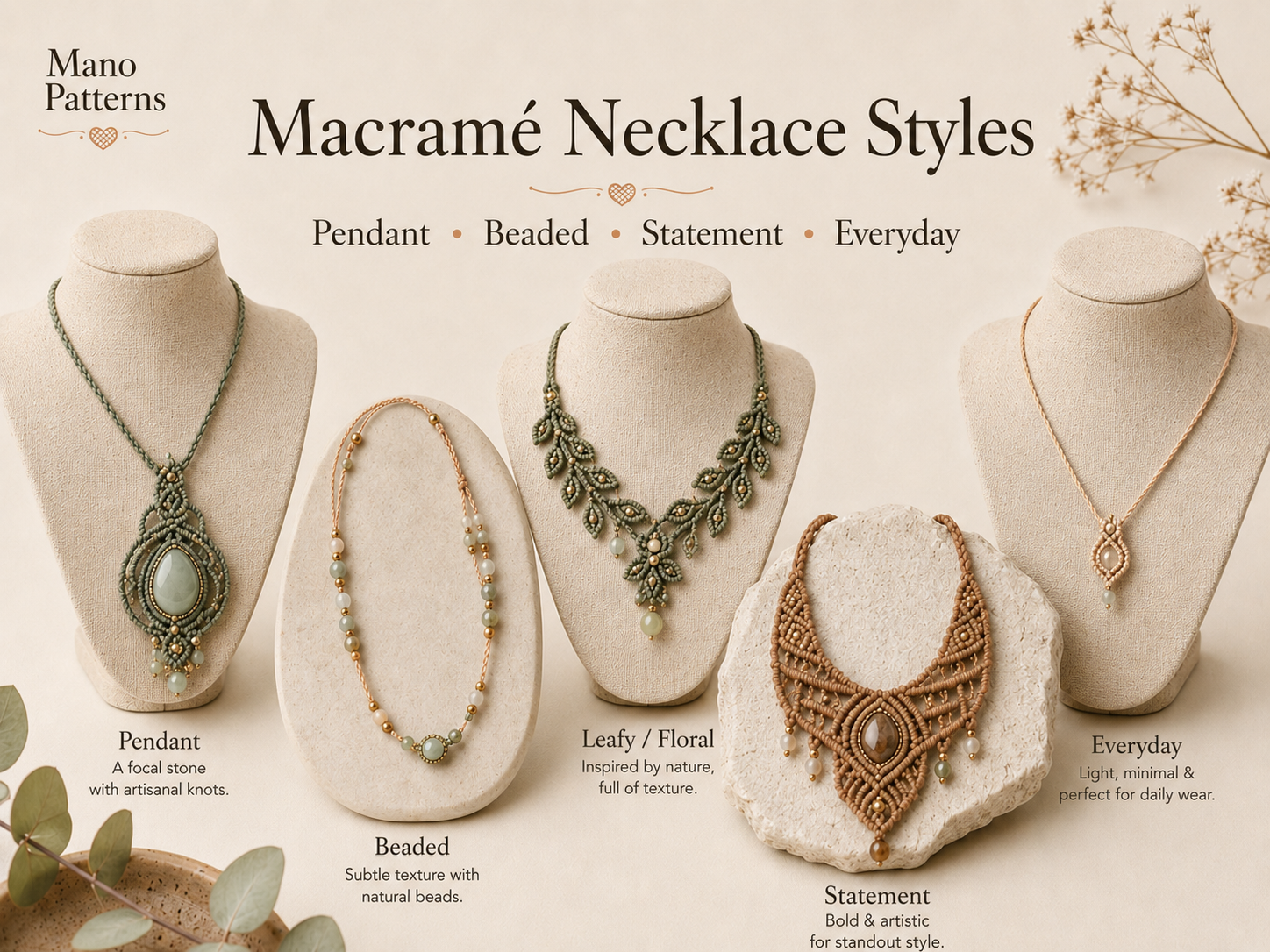
Pendant necklaces
The transition between pendant and neck cords should be secure without becoming bulky.
Test how the pendant hangs before trimming any structural cords.
Gemstone holders
The stone must be supported from several directions.
Gently move the finished frame before trimming to make sure the stone cannot slide out.
Statement pieces
Mark the center first and build mirrored sections outward.
Counting rows on both sides helps keep large designs symmetrical.
Comfort & weight
Heavy stones and metal beads add weight quickly.
Make sure the cord, clasp and attachment points can support the finished piece.
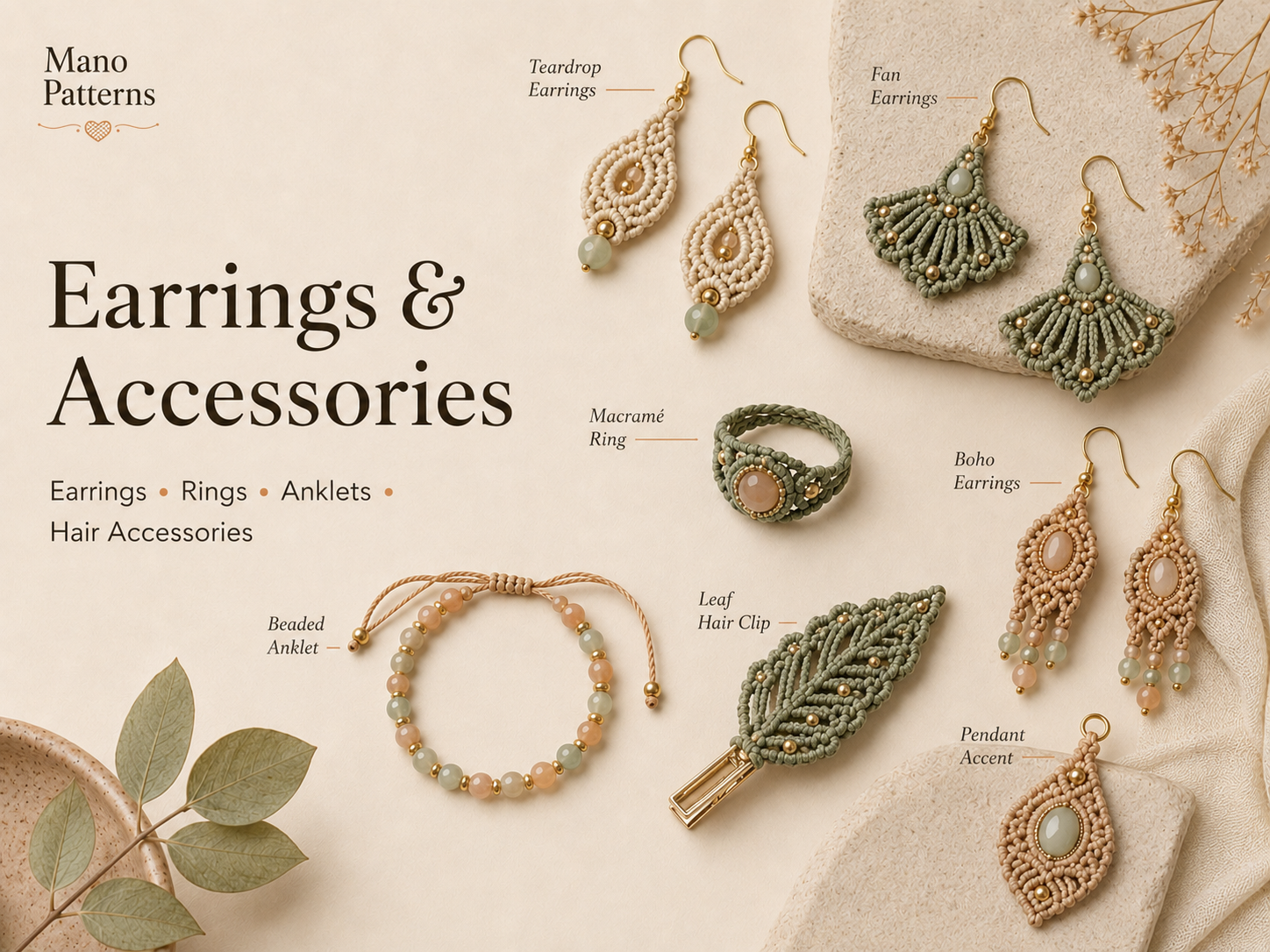
Macramé Earrings & Accessories
Small macrame jewelry projects use less material, but symmetry and finishing become more visible,
especially when two earrings need to match.
Make pairs together
Cut both sets of cords at the same time and compare the two earrings after every main row.
This makes matching tension easier.
Watch the weight
Ear wires, rings, beads and dense knotting can become heavy.
Fine cord and fewer heavy components usually make earrings more comfortable.
Trim fringe last
Let the finished piece hang naturally before cutting fringe.
Trimming while it is twisted or pinned can create an uneven edge.
Close jump rings correctly
Open jump rings sideways with pliers instead of stretching them apart.
This helps them return to their original shape and close without a gap.
Start With an Easy Pattern
Find simple bracelets, necklaces and small jewelry projects that are easier
to follow while you build confidence with the basic knots.
Simple Projects
Build Your Skills
Adding Beads & Gemstones
In macrame jewelry, beads and stones change both the appearance and the construction of a piece.
Plan them before knotting so the cord diameter, bead holes and frame all work together.
Bead-hole size
Check how many cords must pass through each bead.
A hole that fits one 0.8 mm strand may not fit two strands together.
Center focal beads
Position the bead before tightening the next row.
Pulling one side first can move the focal bead away from the center.
Irregular stones
Natural stones are not always perfectly symmetrical.
Build the frame around the real stone instead of forcing identical spacing on both sides.
Check security
Before trimming, gently rotate and move the stone.
If it shifts toward an opening, tighten or rebuild the nearest knots.
Understanding Micro Macramé
Micro macramé uses much finer cord and smaller knots.
The technique allows detailed curves, gemstone settings and beadwork,
but it requires more consistent tension.
Why the detail increases
Finer cord lets you fit more knots into the same space,
creating smoother curves and more intricate motifs.
Why mistakes show more
A small change in knot size is easier to notice when the entire design is miniature.
Work slowly and seat each knot before tightening it.
Useful setup
A firm board, fine pins, strong lighting and sharp scissors make tiny knots much easier to control.
When to try it
Move into micro macramé after you can make even square knots and double half hitches
without constantly adjusting their size.
Macrame Jewelry for Beginners: From Cord to a Finished Bracelet
The exact cord lengths and knot counts depend on the pattern,
but this workflow applies to most beginner bracelet projects.
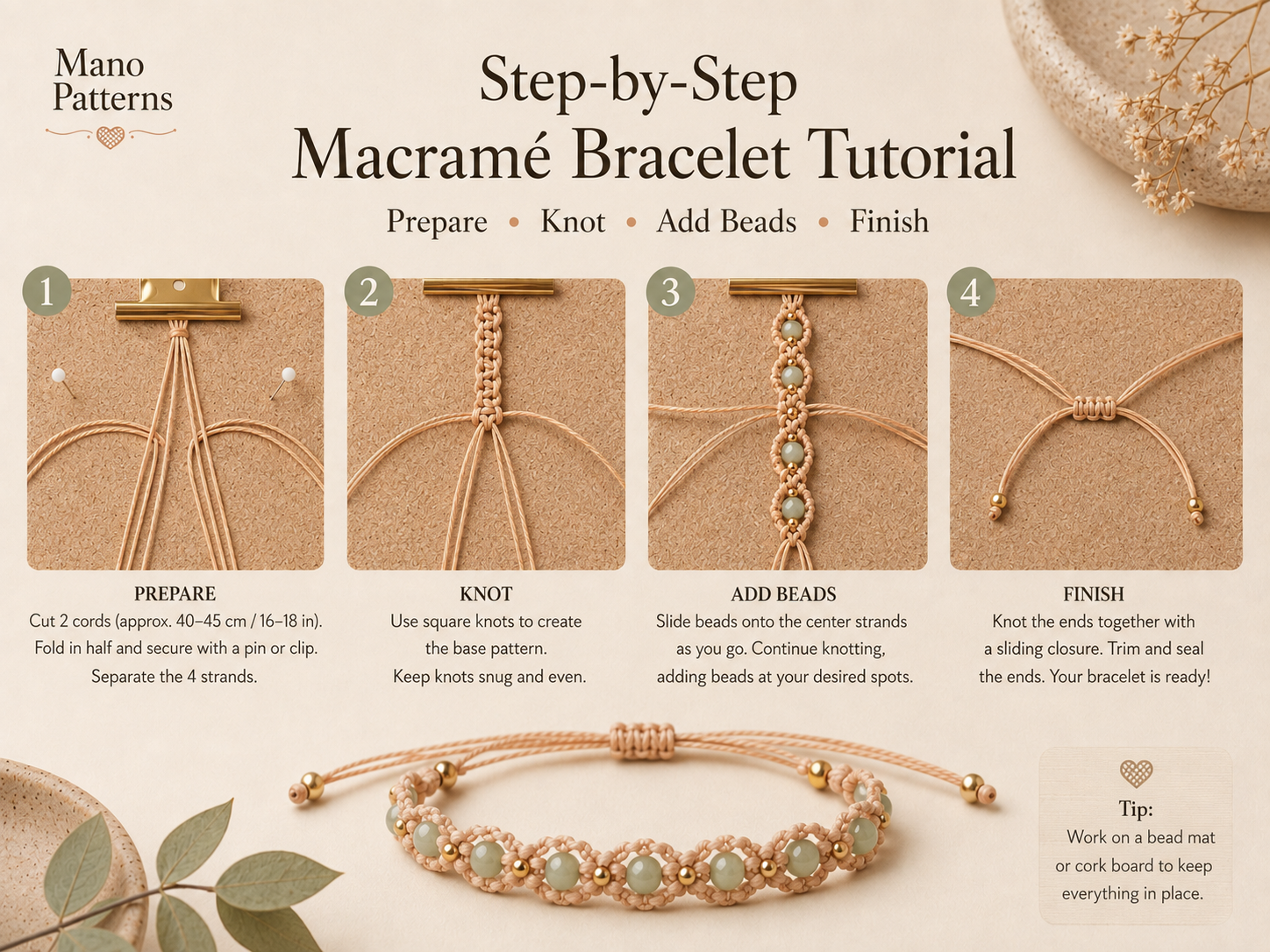
Decide the finished size and whether the bracelet will be fitted or adjustable.
Identify cord lengths, bead placement, knot sequence and closure before cutting.
Separate working cords from filler cords so you always know which strand should move.
Pin or clip the top securely so the piece does not slide when you apply tension.
Make sure the knot direction is correct before repeating it across the bracelet.
Center each focal element before tightening the next row.
Include the closure in the measurement before you finish the last knots.
Secure the ends and check every connection before wearing or gifting the piece.
Closures, Ends & Final Details
Good finishing makes macrame jewelry look intentional and helps prevent the knots from loosening.
Sliding closure
Two bracelet ends overlap and are wrapped with a small knotted section.
It should hold its position but still move when intentionally pulled.
Button-and-loop
Test the loop before trimming. Too large and it may slip open;
too small and the button will be difficult to push through.
Clasps & jump rings
Make sure the jump ring is fully closed and that the knotted attachment
cannot slide through a small gap.
Cord ends
Synthetic and natural fibers require different finishing methods.
Follow the cord manufacturer’s guidance rather than using the same method on every material.
Beginner Troubleshooting
| Problem | Likely cause | Fix |
|---|---|---|
| Bracelet curves | One side is tighter. | Flatten the work frequently and compare both edges. |
| Band twists | The same half-square knot is being repeated. | Alternate the two halves to make full square knots. |
| Bead will not thread | Hole is too small or the cord end is frayed. | Trim the end cleanly and use a compatible bead if needed. |
| Stone feels loose | The frame is too open. | Rework the nearest rows before trimming any cord. |
| Bracelet is too long | Closure length was not included. | Measure the complete piece including clasp or sliding section. |
| Knots look uneven | Tension changes from row to row. | Seat each knot against the previous one before tightening. |
Macramé Jewelry FAQ
Is macrame jewelry suitable for beginners?
Yes. A simple bracelet or pendant using one or two repeated knots is a practical place to start.
What cord size is easiest for a beginner?
Many beginners find approximately 0.8–1.2 mm easier to see and control,
but always follow the size recommended by the pattern when possible.
Which knots should I learn first?
Lark’s head, square knot, half-square knot and double half hitch give you a strong basic foundation.
Can I add beads to macramé jewelry?
Yes. Check that the hole fits the required number of cords and test placement before tightening the next row.
Why does my bracelet twist?
If you intended a flat square-knot band, you may be repeating the same half knot instead of alternating sides.
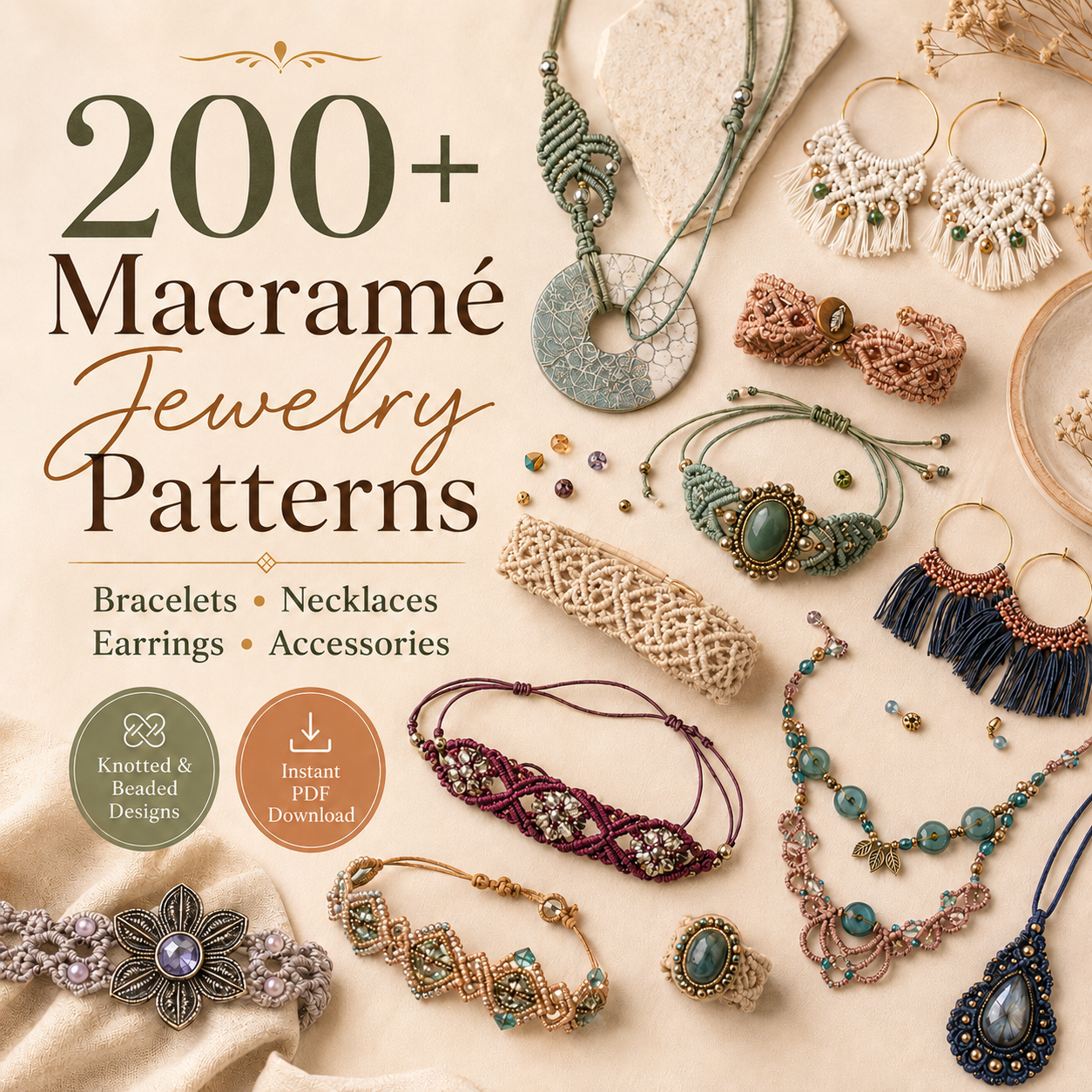
Get the Complete 200+ Pattern Bundle
Keep the full collection in one place with 200+ bracelets, necklaces,
earrings, pendants and more to choose from.
Full Collection
Many Jewelry Styles
More Macramé Guides
Choose the topic you want to explore in more detail next.
Bracelets
Macramé Bracelet Patterns
Styles, structures and project ideas.
Beading
Bracelets With Beads
Bead placement, sizing and design ideas.
Necklaces
Macramé Necklace Guide
Pendants, gemstones and statement styles.
Technique
Macramé Knots for Beginners
Learn the essential techniques step by step.
Materials
Best Cord for Jewelry
Compare cord types, sizes and uses.
Fine Work
Micro Macramé Guide
Fine cord and detailed knotting techniques.
Earrings
Macramé Earrings
Small-scale shapes, findings and fringe.
Beginner
How to Make Macramé Jewelry
A complete beginner workflow.
Gemstones
Crystal Necklace Guide
Stone holders and gemstone designs.